An Influencer Talent Agency Just Sold for $500 Million. Here's What It Means for Brands

The creator economy is officially graduating into enterprise-grade big business. For years, skeptics dismissed influencer marketing as a fleeting digital trend or an experimental line item in seasonal advertising budgets. However, the corporate landscape shifted dramatically when global consulting and advertising holding giants began deploying massive capital to acquire creator infrastructure. Most notably, Publicis Groupe shook the industry by acquiring the AI-powered influencer agency Influential for an estimated $500 million. This staggering valuation was quickly followed by a massive wave of consolidation, including Accenture Song’s acquisition of Whalar to build out its data-driven social commerce capabilities. These landmark transactions send a definitive signal to the corporate world: creators are no longer just an alternative media channel—they are the core infrastructure of modern commerce.
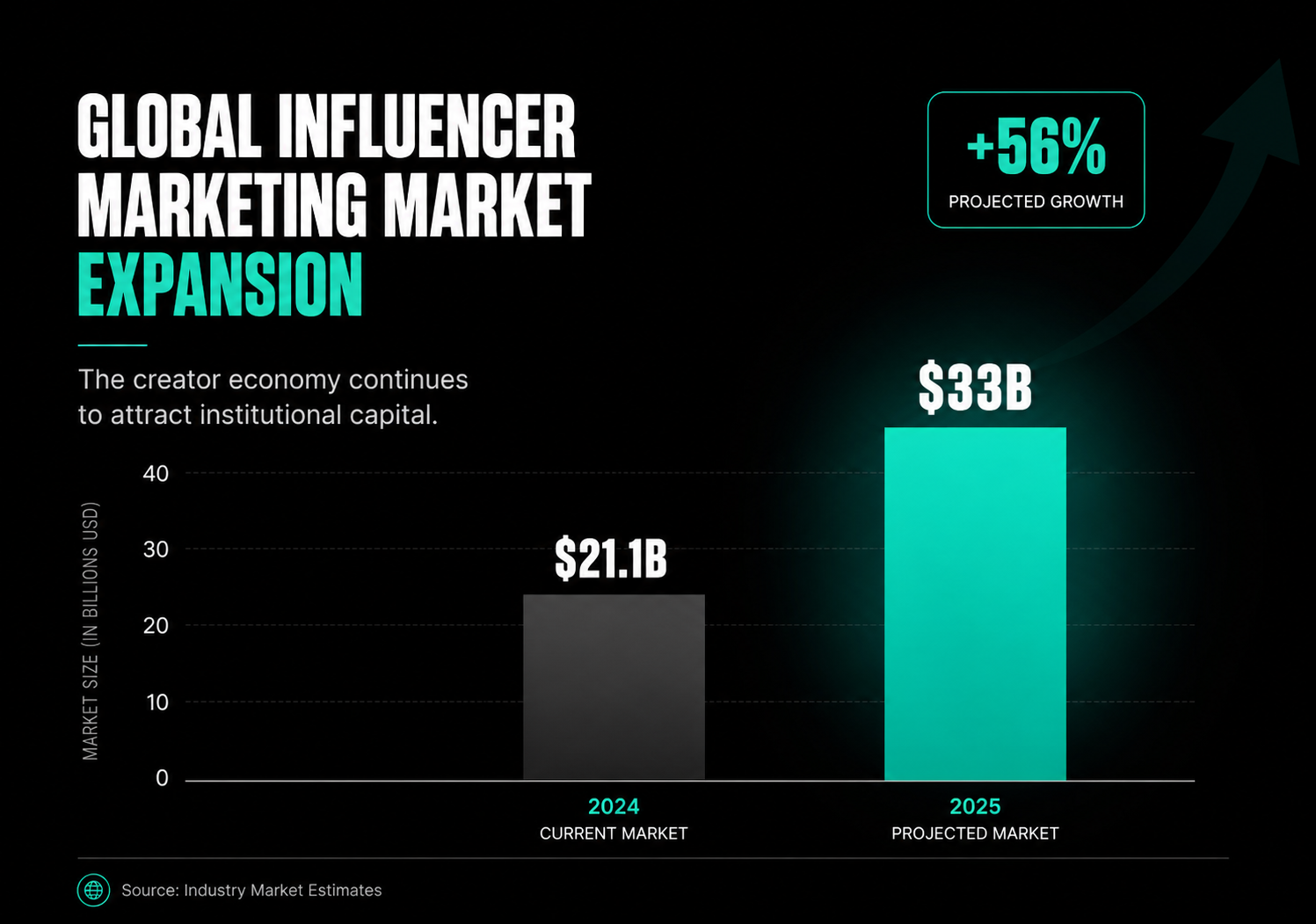
To understand why traditional consultancies and agency holding networks are willing to spend half a billion dollars on creator agencies, you have to look directly at the underlying data. Legacy advertising models are losing their grip on consumer attention, forcing enterprise organizations to hunt for modern alternatives. According to market data from Statista, the global influencer marketing market surged to a staggering $21.1 billion and is projected to reach $33 billion. By acquiring platforms like Influential—which boasts a proprietary AI platform tracking 100 billion data points and a roster that commands 90% of creators with over one million followers—major networks aren't just buying influencer relationships. They are buying sophisticated data networks capable of mapping consumer behavior, forecasting social commerce conversions, and delivering predictable, measurable return-on-investment (ROI) to chief financial officers.
For brands and independent creators navigating this evolution, this half-billion-dollar shift completely redefines the rules of digital strategy. We are officially moving past the era of transactional, "one-off" brand sponsorships where a creator is paid to post a single Instagram story or read a brief video script. Enterprise brands are now utilizing these newly acquired agency networks to build deeply integrated, "always-on" creator commerce ecosystems. Instead of treating social media as an isolated sandbox for brand awareness, corporate giants are plugging creator metrics directly into their primary media mix modeling alongside television, retail networks, and paid search. For creators, this means that data fluency, audience quality scores, and transparent conversion data are becoming just as critical to landing contracts as standard follower counts or creative aesthetics.
To successfully leverage this enterprise shift and protect your brand from getting drowned out by massive corporate budgets, your marketing teams must immediately prioritize building deep creator communities rather than chasing shallow vanity metrics. Stop scrolling through social feeds looking for superficial follower counts and start utilizing data-centric vetting methodologies to source aligned micro-creators and "long-tail" communities. Research shows that smaller, niche-focused creators often yield significantly higher contextual trust and active user participation than broad-reach celebrities. By centralizing communication, utilizing automated tracking systems, and focusing heavily on localized user-generated content (UGC), brands of any scale can build highly conversion-focused creator networks that act as scalable, multi-market engines for organic growth.
Additionally, achieving operational legibility is the ultimate secret weapon for brands fighting to justify their digital marketing budgets to corporate stakeholders. The biggest bottleneck holding back mid-market brand marketing has always been the inability to cleanly translate social engagement into financial revenue data. To operate like the top-tier agencies being bought for $500 million, your marketing workflows must treat creator content as a structured performance discipline. This means integrating your campaign structures with API tracking tools, utilizing dedicated promotional codes, mapping conversion pixel events, and analyzing audience quality data in real time. When you can speak the exact financial language of risk reduction and predictable sales modeling, you elevate your marketing campaigns from speculative digital spending into an essential, revenue-generating asset class.
Ultimately, the $500 million acquisition of scaled influencer infrastructure proves that the future of brand authority belongs entirely to organizations that can successfully blend human authenticity with enterprise data intelligence. The standard playbook of relying on boring corporate messaging or traditional commercial spots is no longer enough to sustain true consumer loyalty in an increasingly fragmented digital ecosystem. To win in this new, highly competitive marketing landscape, organizations must stop viewing creators as a casual add-on and start treating them as an indispensable foundation for customer acquisition, digital product discovery, and modern brand storytelling