A landmark you can't miss, tied to a set you can take home.
LEGO and FIFA put an 8.47-meter replica of the World Cup Trophy in the middle of Rockefeller Plaza — 1.36 million bricks, the largest mobile LEGO build ever made. It's free to visit. There's a Fan Zone around it with building stations, a collaborative brick mural, and custom minifigure creation.
It's a genuine spectacle, and calling it a "community celebration" is accurate. But it's easy to stop there and miss what makes it smart.
The giant trophy is the top of a funnel. And the funnel is the lesson.
Here's the structure. The 27-foot trophy is a landmark — the kind of thing you have to see in person, that pulls people to Rockefeller Plaza and onto their feeds. Admission is free. The Fan Zone is free. None of it asks for a dollar.
But the whole thing is tied to product. Lego released a buildable version of the trophy fans can actually own, plus a line of footballer minifigure sets. You stand in front of the giant one, you play at the free stations, and you leave wanting the small one for your shelf. The free experience converts foot traffic into retail intent without ever running a hard sell.
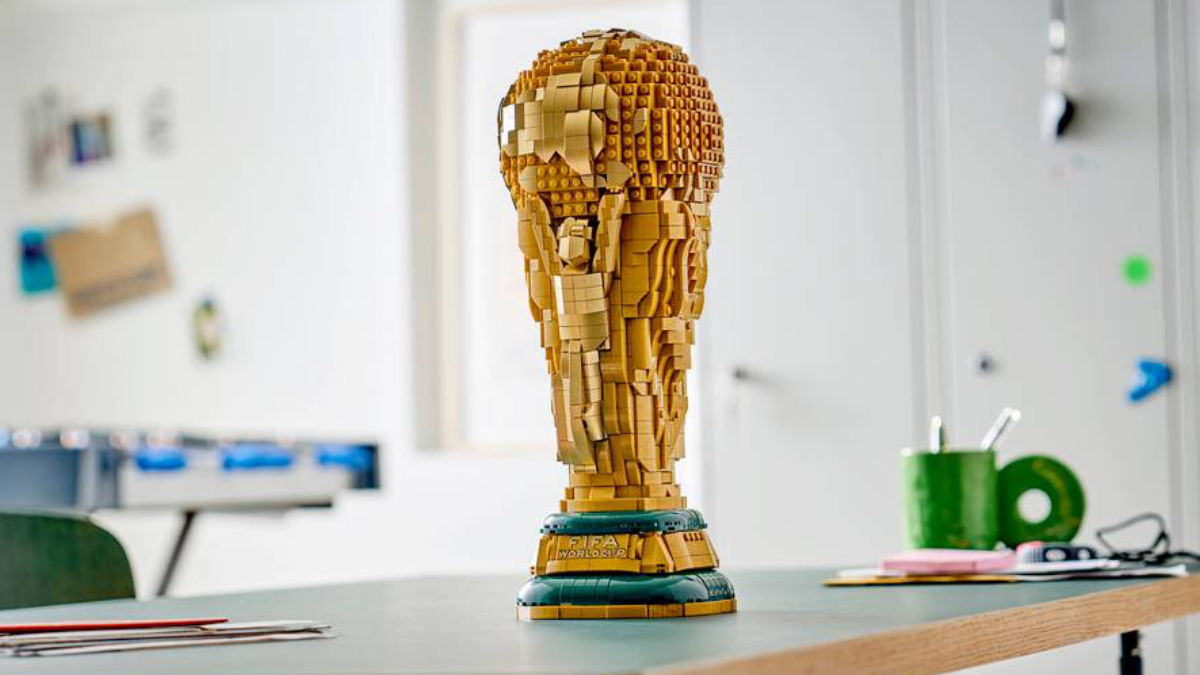
That's not community instead of commerce. It's community as commerce — the warmest possible top of a sales funnel.
A free experience and a paid product aren't opposites — the first can feed the second. Give people something genuinely fun and free to show up for, then make sure there's something small they can buy and take home. The free part earns the goodwill and the foot traffic; the paid part is waiting right there when the goodwill peaks.
Most experiential marketing stops at the photo. People show up, snap a picture, post it, leave. The brand gets reach but nothing else.
Lego added a step: you can take a piece of it home. The photo is free reach, but the buildable set is a lasting object in someone's house — a daily reminder of the brand that a screenshot never becomes. The souvenir is what turns a moment into a purchase and a purchase into a fixture.
If you build a moment people want to photograph, ask what they can leave with. A small product, a takeaway, a thing they keep. The photo travels; the object stays. Both are worth designing on purpose, and most brands only build the first.
Nobody chooses to watch an ad. People choose to walk to Rockefeller Plaza and stand in front of a giant Lego trophy. That difference is the whole point of a physical landmark: attention you're given freely is worth more than attention you interrupt someone to take.
The scale is what earns the choice. At 25 times the size of the real trophy, it's a "you have to see this" object. Not because big is clever, but because big is a reason to make the trip and pull out a phone.
The strongest activation is one people seek out rather than sit through. You won't build a 27-foot anything, but the principle scales down — a mural, a window, an installation, a photo-worthy corner of your space. Something worth a detour. Chosen attention beats interrupted attention every time.
You don't have 1.36 million bricks or a Rockefeller Plaza lease. The structure still copies down.
Build one thing worth seeing in person. A mural, a window display, a small installation — something photo-worthy that gives people a reason to come by.
Make it free and easy. No purchase to participate. The goodwill and the foot traffic are the point.
Have the souvenir ready. A small product, a takeaway, something they can buy and keep when the moment lands. The free part earns the visit; the paid part is waiting.
The lazy read is "Lego spent a fortune to celebrate football." The real read is that Lego built the warmest sales funnel of the tournament — a free landmark that pulls a crowd, a free Fan Zone that keeps them there, and a buildable set waiting for them to take a piece home.
You don't need the budget. You need the structure: something worth seeing, free to enjoy, with something small to buy when the goodwill is at its peak.
Build the thing people choose to visit. Then give them something to carry out the door.